The invitation says 'Sweet 16', and suddenly a birthday gift feels as though it needs to make a statement. Something grown-up, perhaps - but not too grown-up. Something memorable - but preferably not destined for a cupboard.
Sweet 16 is a sixteenth-birthday celebration that recognises growing independence, especially within North American birthday culture. It is a social milestone, not a universal ceremony, and it comes with no compulsory party format or gift list.
That distinction takes some pressure off. You do not need to recreate an elaborate tradition to mark the occasion properly. Understanding where Sweet 16 fits in the wider story of coming of age makes it easier to choose something practical, playful or sentimental that means something to the teenager receiving it.
Where did the Sweet 16 tradition come from?
Sweet 16 does not have a single, securely established invention date. The modern celebration is most closely associated with the United States and Canada, but it is better understood as an evolving birthday custom than a ceremony created by one person at one moment.
Its broader context is much older: communities have long marked the transition between childhood and adulthood. As Encyclopaedia Britannica's explanation of rites of passage shows, these transitions can involve ceremonies that recognise a change in someone's social position. That helps explain the appeal of a milestone birthday, but it does not prove that every coming-of-age celebration shares the same origin.
Even the phrase 'sweet sixteen' has a history separate from today's party customs. James Thornton's song When You Were Sweet Sixteen was published in 1898. It provides a dated example of the phrase in popular culture - not evidence that the song invented the birthday celebration. A romantic song title and a formal party tradition are different things.
Sweet 16 is also sometimes compared with debutante presentations, because both can recognise a young person entering a new stage of social life. The comparison is understandable, but similarity is not proof of a direct, universal line of descent. A birthday dinner with friends is not simply a smaller debutante ball.
Nor is Sweet 16 interchangeable with a quinceañera. A quinceañera traditionally marks a fifteenth birthday and has its own cultural and, in many celebrations, religious significance. Calling it an earlier Sweet 16 flattens two distinct traditions into one.
The useful conclusion is less dramatic than a tidy origin legend: Sweet 16 belongs to a wider history of recognising growing independence, while its particular customs vary between families and communities. There is no need to borrow somebody else's ceremony to make the birthday meaningful.
Why does sixteen feel like a milestone?
For many teenagers, sixteen sits in an interesting middle ground. They may be gaining more say over their friendships, interests, appearance and plans, while still relying on family support. The significance is often this growing sense of agency - not a sudden overnight transformation into an adult.
What that looks like differs enormously. One teenager may be thinking about a first job; another is absorbed in music, sport, art or gaming. Someone else may simply want their birthday plans to reflect their own taste rather than the party adults imagine they should have.
Age-based rules around driving, employment and other responsibilities also vary by location. Sweet 16 should not be treated as a universal legal threshold, or as a signal that adult-only gifts are appropriate.
This is where the buying difficulty usually begins. Adults want to acknowledge the milestone, but can accidentally shop for an imagined 'grown-up version' of the recipient. The teenager, meanwhile, would quite like something connected to the person they are now.
A useful starting point is the change you have actually noticed. Have they become the friend who organises game nights? Are they spending hours drawing? Have they started caring about how their desk or room works? Those observations are stronger clues than the number printed on the invitation.
The milestone can also mean different things to different people in the same family. A parent may feel nostalgic; the birthday person may feel excited about what comes next. A thoughtful gift leaves room for both, without making the teenager responsible for performing everyone else's emotions.
Which Sweet 16 traditions do you actually need to follow?

There is no universal Sweet 16 ritual you must follow. The right approach is to respect the recipient's wishes, their family's customs and any guidance on the invitation. A quiet celebration is not an incomplete version of a grand one.
You may encounter several familiar elements, each with a different purpose:
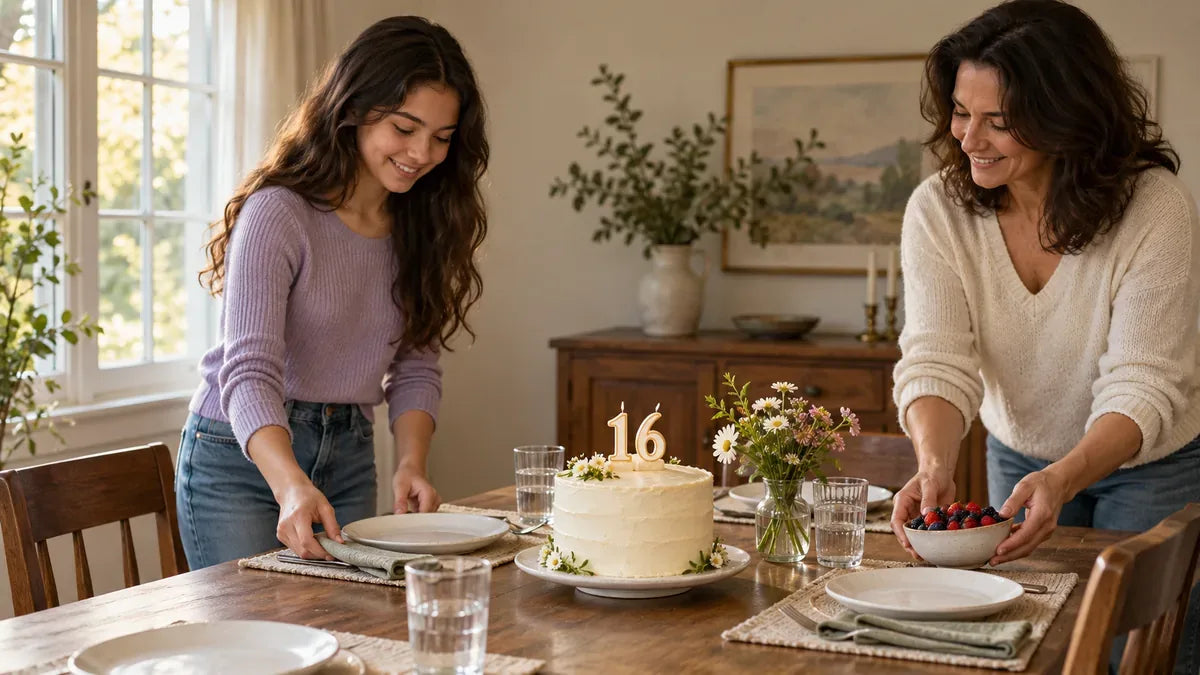
- Cake and candles: These can provide a shared birthday moment without turning the occasion into a formal ceremony. The recipient may prefer a small gathering to a roomful of people watching them make a wish.
- A candle-lighting or thank-you ceremony: Some celebrations use this to acknowledge important people. It can be meaningful when the teenager wants to participate, but it should not become compulsory public speaking.
- A special entrance, dance or dress code: These belong to some party styles, not to the definition of Sweet 16. Follow the host's plans rather than assuming the event requires formalwear or a choreographed moment.
- A lasting or symbolic gift: Jewellery, watches, albums and other keepsakes can mark the occasion. Their meaning comes from the relationship and the recipient's taste - not from being mandatory milestone purchases.
The same flexibility applies to presents. There is no universal requirement for a parent, grandparent or friend to give a particular object. Cash or a contribution towards a wanted purchase can be appropriate, especially when the family is comfortable with that approach. There is no standard amount that makes it 'proper'.
If you are attending a party, check the invitation before buying. Requests for no gifts, contributions or a shared present deserve more weight than general birthday etiquette found online.
Presentation can carry some of the significance, too. A practical item becomes more personal with a note explaining why you chose it. A keepsake becomes less generic when it includes a specific memory rather than a pre-written message about growing up.
The tradition worth preserving is recognition: 'We see who you are, and we're pleased to celebrate you.' Everything else can be adapted.
What makes a Sweet 16 gift feel right?

Once the ceremonial pressure is removed, the gift decision becomes clearer. Choose something that supports an interest, creates enjoyment or preserves a connection. These purposes can overlap, but knowing which matters most helps prevent a shopping basket full of unrelated possibilities.
Practical gifts should support something they want to do
A useful gift works well when the recipient has a clear routine or frustration you understand. That could be a desk accessory for someone who enjoys making their space their own, an audio accessory for a keen listener, or equipment connected to a hobby they already pursue.
For a technology-minded teenager, LatestBuy's electronics and gadgets collection is a relevant browsing path - but start with the intended use, not the most impressive-looking object. Something for listening, charging or organising needs to suit their actual setup.
Compatibility matters more than clever packaging. Check device connections, charging requirements, dimensions and anything else needed to use the item. If it depends on an app, account or subscription, understand those requirements before making it somebody else's birthday responsibility.
Practical gifts are less successful when they feel like instructions to become a different person. A teenager who loves drawing may appreciate art materials; one who has never expressed that interest may see a creative kit as assigned homework. The difference is evidence of enthusiasm.
Playful gifts should match how they have fun
A playful gift can acknowledge sixteen without making the occasion overly serious. Games, puzzles and shared activities are especially useful when the recipient enjoys spending time with friends or family.
LatestBuy's family games collection offers a focused starting point for that kind of discovery. Look beyond the theme and consider how the game would fit into their life.
A quick card game may suit a casual birthday gathering. A longer strategy game makes more sense for someone who enjoys learning rules and returning to a game over several sessions. Check the age guidance, player count, typical playing time and whether the group prefers competition or cooperation.
Also distinguish between a present for the birthday person and entertainment for everyone else. A game chosen solely to occupy party guests may not reflect the recipient's interests.
Humour needs the same care. An affectionate joke can work; a gift built around embarrassment, appearance or private information can land very differently when opened in front of relatives. Aim for something they will enjoy after the first laugh, not just something that gives the room a reaction.
Keepsakes should preserve their story, not impose yours
A keepsake suits a recipient who enjoys personal objects, photographs, memories or displaying things connected to their interests. It does not need to be expensive, engraved or decorated with a large '16'.
An album with room for future memories, a journal accompanied by a personal message, or a display piece connected to a lasting interest can all carry significance. The important question is whether the recipient would choose to keep it.
Be particularly careful with childhood nostalgia. A favourite character or hobby may still matter deeply-or it may be something adults remember more fondly than the teenager does. Check that the connection is still welcome.
For a collectible or display gift, think about duplication, available space and how they like to keep things. Someone who preserves packaging may need room for the box as well as the object. A large decorative piece can create an obligation to display it, so dimensions and personal taste matter.
Personalisation deserves similar restraint. Confirm spelling, dates and wording before ordering, and check the seller's terms for personalised items. A discreet inscription often leaves more room for changing tastes than a design dominated by the birthday number.
There is no requirement to choose sentiment over usefulness. A well-chosen everyday object can become a keepsake because of who gave it and when.
How do you match the gift to your relationship and budget?

Your relationship helps determine how personal the gift can reasonably be. It does not set a compulsory spending level.
Parents and close carers may know about a larger purchase the teenager has been considering. That makes it easier to coordinate, contribute or agree on specifications before buying. There is nothing less thoughtful about confirming the exact version of something they want.
Grandparents and other relatives may have a shared memory that gives a modest gift extra meaning. The strongest connection is usually specific: a hobby you introduced them to, a place you visited together, or something you still enjoy doing.
Friends and siblings often have excellent knowledge of current interests and running jokes. That insight can be more useful than a bigger budget. If pooling money for a group gift, agree on the contribution before anyone purchases it, and make sure nobody feels pressured to join.
When you know the recipient less well, reduce the amount of guesswork. Ask a parent, close friend or the teenager themselves for one current interest or wish-list idea. A narrow question-'Would you use a game with friends, or would you rather choose something for your desk?'-is often easier to answer than 'What do you want?'
Set your spending limit before browsing. LatestBuy's under-$30 collection can be a useful budget-led starting point when you want to keep the gift modest. It is a browsing boundary, not a suggested amount everyone should spend.
For a larger purchase, account for anything needed to make it usable: accessories, consumables, ongoing costs or space. If those details are unclear, a contribution towards the recipient's chosen item may be more considerate than an expensive surprise.
Then let your next browsing step follow what you have learnt:
- A clear practical interest: Compare items for the same use, checking compatibility and everyday usefulness.
- A social or playful recipient: Compare games or activities by the group they will actually use them with.
- A sentimental recipient: Choose a connection first, then an object that can carry it comfortably.
- No clear interest yet: Use LatestBuy's gift guide to compare different gift categories with the recipient or someone who knows them well. Broader browsing is useful here because you are still discovering the direction - not because every popular gift will suit a sixteen-year-old.
The invitation may call it Sweet 16, but the best buying clue is still the person's name above it. Mark the milestone in a way they recognise as theirs: something they will use, something they will enjoy, or something they will genuinely want to keep.