Halloween did not begin in one place, on one date or with one neat set of rules. The celebration observed on 31 October developed through a mixture of ancient Gaelic seasonal customs, medieval Christian observances, British and Irish folk traditions, migration to North America and, eventually, popular culture and commerce.
Its name comes from All Hallows' Eve, the evening before All Saints' Day on 1 November. Seasonal ideas associated with Samhain, including the arrival of winter and stories about the otherworld, also influenced later traditions. Costumes, door-to-door visits, carved lanterns, parties and lollies arrived or changed at different points.
In other words, the history of Halloween is less a straight family tree and more a very old costume cupboard: every generation has opened it, kept a few pieces and added something new. These five common myths reveal how the celebration became the familiar mix of frights, fun and gift-worthy mischief we know today.
Myth 1: Halloween began as a single Celtic celebration
Samhain is often described as the one and only origin of Halloween. The reality is more complicated.
Samhain was an important Gaelic seasonal festival associated with the end of the harvest period and the beginning of winter. It appears in medieval Irish literature, while later Irish and Scottish folklore connects the season with bonfires, feasting, divination and encounters with supernatural beings. In a farming society facing longer nights and harsher weather, the threshold between seasons naturally carried weight.
However, historians cannot draw an uninterrupted line from every ancient Samhain practice to every modern Halloween custom. Evidence from the earliest periods is limited, traditions varied between communities, and many descriptions were written down long after the eras they supposedly recorded. "Celtic" also covers different peoples and places rather than one uniform religion with a universal Halloween handbook.
Christian observances added another major layer. By the medieval period, 1 November was widely observed in Western Christianity as All Saints' Day, also called All Hallows' Day. All Souls' Day followed on 2 November in many communities, creating a period known as Allhallowtide in which the dead, saints and departed souls were remembered. The preceding evening became All Hallows' Eve, later shortened to Hallowe'en or Halloween.
These calendars and customs did not necessarily replace older seasonal traditions cleanly. They overlapped, interacted and took on local forms. Popular summaries sometimes add Roman festivals, particularly one honouring Pomona, to the story; evidence for a tidy direct connection is thin, so that claim deserves more caution than it usually receives online.
The most accurate answer is therefore that Halloween has both pre-Christian and Christian influences, plus centuries of folk practice. Treating it as exclusively pagan or exclusively Christian misses the interesting bit: communities repeatedly adapted the season to match their own beliefs, fears and social lives.
Myth 2: Costumes are a modern fancy-dress invention
Shop-bought costumes and character outfits may be modern, but dressing up for the season is not.
Masking, mumming and guising appeared in various European celebrations long before Halloween parties came with photo booths. These traditions allowed people to disguise themselves, visit neighbours and perform short songs, rhymes or comic routines. Later records from Ireland and Scotland describe Halloween guisers going from house to house in costume, sometimes receiving food or small rewards in return for entertaining the household.
Medieval souling is another possible influence. Around Allhallowtide, poorer people and children in parts of Britain and Europe visited homes and received food, including "soul cakes", in exchange for prayers for the dead. It resembles modern door-knocking in broad outline, although it would be too simple to call it trick-or-treating with older snacks.
As Halloween developed in North America during the 19th and early 20th centuries, disguises became part of parties, community events and neighbourhood celebrations. Homemade outfits might use old clothes, sheets, masks and whatever else could survive enthusiastic improvisation. Mass-produced costumes and familiar figures from film, television and comics became more prominent later.
Costumes have also changed in purpose. A disguise once linked with ritual, anonymity or unsettling the neighbours can now express humour, nostalgia, fandom, creativity or group belonging. Some people want a convincing transformation; others are delighted by a cardboard hat and a questionable accent. Both are participating in the same long habit of becoming somebody-or something-else for the night.
The practical rule is to choose for the setting rather than for maximum spectacle. A school event, office party, outdoor walk and crowded evening venue create different requirements. Think about visibility, movement, weather, age suitability and whether the theme could make someone else's culture or identity into a punchline. The best costume is not merely recognisable; it lets the wearer enjoy the event without tripping over a cape every seven minutes.
Myth 3: Trick-or-treating has followed the same rules for centuries

Door-to-door customs have old precedents, but modern trick-or-treating is largely a 20th-century development.
Souling and guising help explain why visiting houses in return for food or rewards did not appear from nowhere. In some communities, seasonal visitors offered prayers, performances or playful demands. Halloween also became associated with pranks, particularly among young people. Gates were moved, objects disappeared and mild chaos occasionally graduated into property damage. The "trick" was not always theoretical.
The phrase "trick or treat" began appearing in Canadian and American newspaper reports during the 1920s and 1930s. Community organisers increasingly promoted supervised parties and house-to-house treat collecting as ways to channel youthful mischief into something more manageable. Migration, expanding suburbs, changing family life and local media all helped the custom spread.
The treat itself changed too. Homemade food, fruit, nuts, coins and small objects all appeared at different times and places. Packaged confectionery became increasingly dominant after the Second World War as sugar became more readily available, manufacturers promoted individually wrapped sweets and households favoured convenient items that were easy to distribute. The familiar bowl of miniature lollies is therefore not an ancient relic. It is the result of industrial production meeting a neighbourhood ritual and deciding they made an excellent team.
Today, trick-or-treating works because everyone broadly understands the exchange: participating homes indicate that visitors are welcome, children make a short request, treats are given, and the threatened "trick" remains mostly ceremonial. Local rules vary, and not every household or community participates.
That variation matters when planning treats. Food allergies, dietary requirements, age and caregiver preferences can make a seemingly simple bowl more complicated. Individually presented food with clear information is easier for families to assess, while non-food tokens can include more children but may create clutter or age-suitability concerns. The aim is not to win the street with the biggest haul. It is to make the interaction easy, cheerful and comfortable for the people at the door.
Myth 4: Pumpkins and spooky symbols were there from the beginning

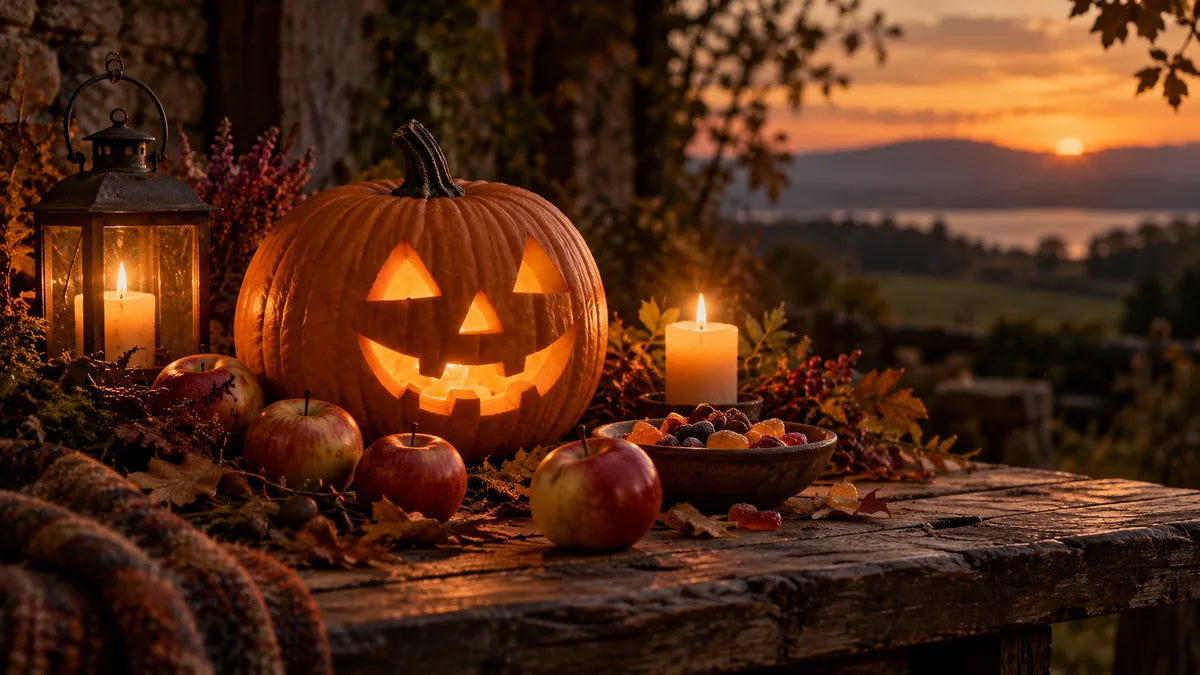
The pumpkin is Halloween's grinning mascot, but it joined the celebration after earlier lantern traditions were already established.
In Ireland, Scotland and parts of Britain, people carved faces into turnips and other root vegetables. The exact purpose varied by place and retelling: the lanterns could represent spirits, repel them, light a path or simply startle anyone unfortunate enough to meet a glowing vegetable in the dark. Stories about "Stingy Jack" are frequently offered as the definitive origin of the jack-o'-lantern, but folklore changes over time and should not be treated as one proven starting point.
When Irish and other migrants carried Halloween customs to North America, pumpkins offered an appealing substitute. They were available, large, hollow and considerably more cooperative than a stubborn turnip. Pumpkin carving became increasingly prominent, eventually producing everything from simple triangle-eyed faces to elaborate designs that require more patience than some people bring to major home renovations.
Other Halloween symbols have equally mixed histories. Ghosts and skeletons reflect longstanding associations with death and remembrance. Witches draw on centuries of European folklore, persecution, literature and stage imagery rather than one Halloween source. Bats are nocturnal, cats have accumulated layers of superstition, and orange and black conveniently suggest harvest fire, autumn colour and night. Printed cards, decorations, films and advertising helped standardise this visual vocabulary during the late 19th and 20th centuries.
Even party games preserve older seasonal ideas. Apples were linked with harvest celebrations, and games involving peels, mirrors or names sometimes claimed to reveal a future spouse. Bobbing for apples now feels like chaotic party entertainment, but it belongs to a larger tradition of using Halloween to peek-supposedly-into the future.
For a modern celebration, symbols work best when they establish the intended mood. Young children may enjoy smiling pumpkins and friendly creatures; committed horror fans may want something much darker. If reusable atmosphere matters more than accumulating decorations, browsing electronics and gadgets can provide a starting point for comparing practical lighting, sound and party-tech ideas. Check the room, setup and audience before turning an ordinary lounge into a mildly alarming laboratory.
Myth 5: Halloween is only for children, sweets and scares
Children in costumes may be the most visible part of Halloween, but the celebration has long included adult gatherings, shared food, games, storytelling and social rituals.
Historical Halloween parties could feature music, dancing, harvest food and fortune-telling games. Modern versions range from neighbourhood events and family film nights to elaborate costume parties. Some people chase a proper fright; others prefer a cosy evening involving snacks, a game and a decorative pumpkin that looks more confused than menacing.
Gifting is a newer extension rather than an ancient requirement. Halloween has never centred on formal gift exchange in the way some major religious or family holidays do. Even so, food, hospitality, party prizes and small tokens have long accompanied the season. Contemporary practices such as themed care packages and "boo baskets" build on that social instinct, but they should not be mistaken for customs handed down unchanged from distant ancestors.
A Halloween gift works when it supports the recipient's version of the occasion:
- For a host or household, choose something that can be used during the event. A shared activity is often more useful than another ornament, particularly when storage is limited. The family games collection is a sensible place to compare options for a relaxed evening, provided the player count, age guidance and expected playing time suit the group.
- For children and families, consider household rules before choosing food, noisy novelty items or frightening designs. Creative activities and group entertainment can avoid dietary complications, but age suitability and supervision still matter.
- For friends or colleagues, keep the gesture proportionate to the relationship. If it is meant to be light rather than lavish, gifts under $30 can help set a clear budget boundary. Public appropriateness matters too: a joke that works among close friends may become rather less enchanting in the office kitchen.
- For costume, horror or pop-culture enthusiasts, personal taste matters more than generic spookiness. Display pieces and collectibles can feel thoughtful when you know the recipient's interests, but they also bring duplicate and space risks. If the details are fuzzy, use a broader LatestBuy gift guide to compare practical, playful and nostalgic directions before choosing.
- For anyone avoiding more "stuff", favour something consumable or activity-led. Check dietary needs for food, and remember that a game or gadget still needs to fit the person's routine rather than merely matching the date.
The category trade-offs are straightforward. Treats are easy to share but need dietary awareness. Games create a social moment but depend on the right group. Gadgets may be reusable but can demand setup, compatibility or storage. Collectibles offer strong personal relevance but require knowledge of taste and display space. Novelty gifts can land brilliantly-or produce the polite smile of someone wondering where on earth to put them.
Recipient fit, occasion pressure and budget comfort should therefore outrank the urge to make everything aggressively orange. Halloween gifting is at its best when it adds to the ritual instead of competing with it.
The practical reality: choose the ritual before the thing

Halloween's traditions make more sense when viewed as tools for creating a particular kind of night. Costumes let people experiment with identity. Lanterns transform familiar spaces. Treats turn a doorstep encounter into a shared ritual. Games give a gathering structure. A small gift can thank a host, include someone who cannot eat the usual lollies or keep the fun going after 31 October.
Before buying or planning anything, decide which moment you are supporting:
- Name the occasion. Is it trick-or-treating, a children's event, an adult party, a family night or a host gesture?
- Set the tone. Friendly, funny, nostalgic and genuinely frightening are not interchangeable.
- Check the practical friction. Consider allergies, age, noise, setup, costume movement, storage and display space.
- Keep the scale appropriate. A casual seasonal surprise should not create awkward obligation. If tastes remain unclear, top-selling gifts can reveal popular browse directions, but popularity should inform the choice rather than replace personal judgement.
- Choose participation over decoration when possible. Something to play, use, share or remember usually contributes more than an object selected solely because it has a bat printed on it.
For broader inspiration, the LatestBuy gift discovery page offers routes across different recipients, budgets and product types. Or begin at LatestBuy and follow the category that best matches the Halloween moment you are actually creating.
That is Halloween's real trick: it keeps changing while making its borrowed, blended traditions feel wonderfully familiar.